There is more than one way to contribute.
MLCast is a collaborative community advancing weather nowcasting through machine learning by openly sharing datasets, software, experiments, and expertise.
Scientists, researchers, software engineers, and curious builders can all contribute in different ways.
Ways to contribute to MLCast
Share Data
Contribute datasets, ingestion pipelines, or data schemas that help the project grow.
Your work makes testing more realistic and results more useful for everyone.
A well-prepared dataset can become the foundation for many new experiments.
Right now we focus on gathering radar precipitation across Europe — and we're working to grow that coverage country by country.
Satellite data support is coming soon — broadening MLCast beyond radar for richer, global nowcasting.
Dataset Catalog
Radar precipitation
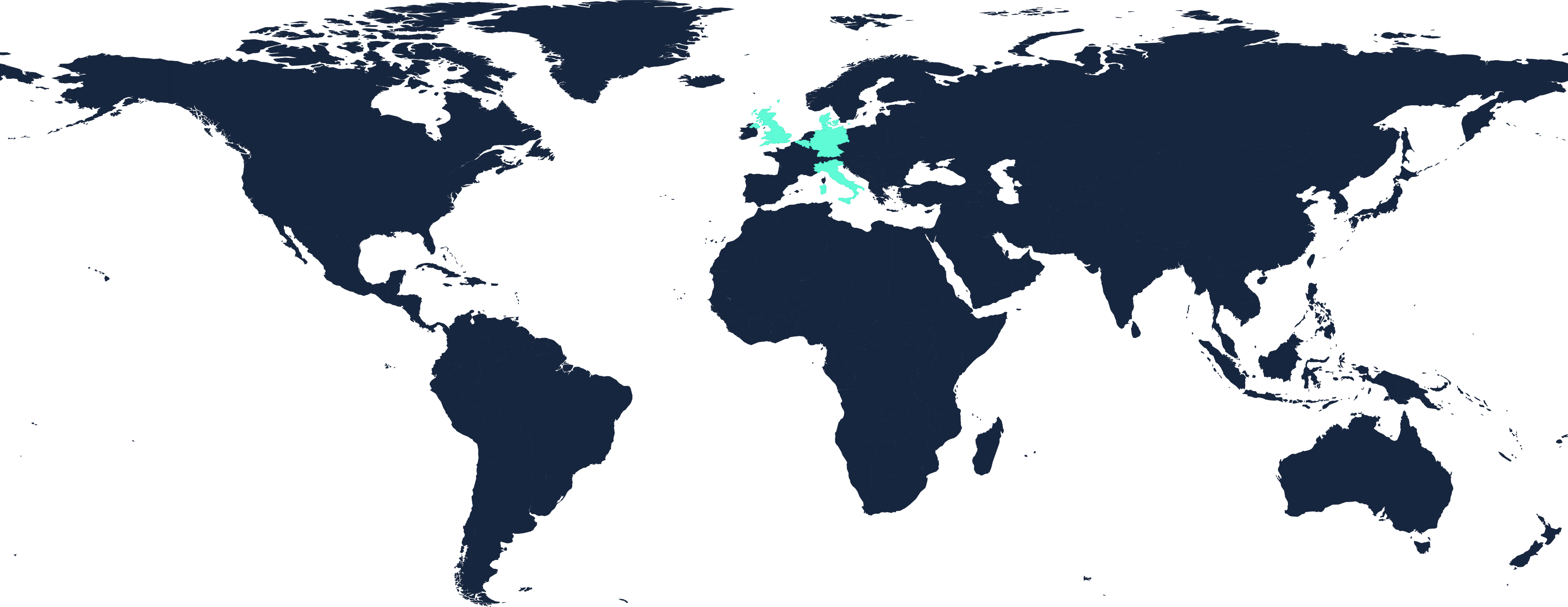






Countries
6
Years of rain
~97
Cadence
5m
Help us expand coverage — is your country missing?
Contribute Code
Turn ideas and models into real tools, features, APIs, and integrations that the whole community can build on. You help make mlcast more usable, stable, and ready for real-world nowcasting workflows — from research notebooks to operational pipelines and even a small improvement can make the whole project easier to adopt, whether it is a cleaner API, better error messages, or a missing test.
No contribution is too small: a bug fix, a new model architecture, or a refactor all move the ecosystem forward.
Things you can do
- Add a new model architecture
- Fix bugs
- Improve the codebase
- Build data pipelines
Train a Model
Try new architectures, tune parameters, and explore different nowcasting approaches.
You help improve accuracy, stability, and the overall performance of the models.
Watch the loss curves converge, keep an eye on gradient flow, and push spatio-temporal backbones like ConvGRU further.
Things you can do
- Try new architectures
- Tune hyperparameters
- Design new loss functions
- Extend the forecast horizon
Validate Results
Before any dataset reaches the public catalog, it passes through the dataset validator: an automated check that verifies schema, spatial and temporal coverage, units, and missing-data ratios so every contribution stays consistent and reusable.
The same rigor applies to models. Forecasts are scored against shared baselines with standard nowcasting metrics — MSE, MAE, CRPS, and AFCRPS — across lead times and extreme-rainfall cases, so performance claims are reproducible and comparable.
Reviewing these checks, spotting edge cases, and improving the validator keeps the project on a stronger, more trustworthy foundation. Your critical eye helps the community understand what truly works and what needs improvement.
View mlcast-benchmarksSupport the Community
MLCast grows on shared effort and shared resources. There are many ways to keep the project moving forward.
Help us obtain GPU hours so we can train, tune, and benchmark larger nowcasting models the community can reuse.
Improve the documentation with guides, examples, and clear explanations that lower the barrier for new contributors.
Help spread the word to bring in more datasets, ideas, and people who can push the project further.
Join SlackCurrent Support
Infrastructure powering MLCast
DWD
EWC S3 allocation for MLCast datasets
CINECA
10,000 GPU hours on Leonardo HPC
Enabled via EUMETNET E-AI · Working Group 6


Start with a conversation.
You do not need a finished idea. Tell us what you are interested in and we’ll help you find a useful first step.